
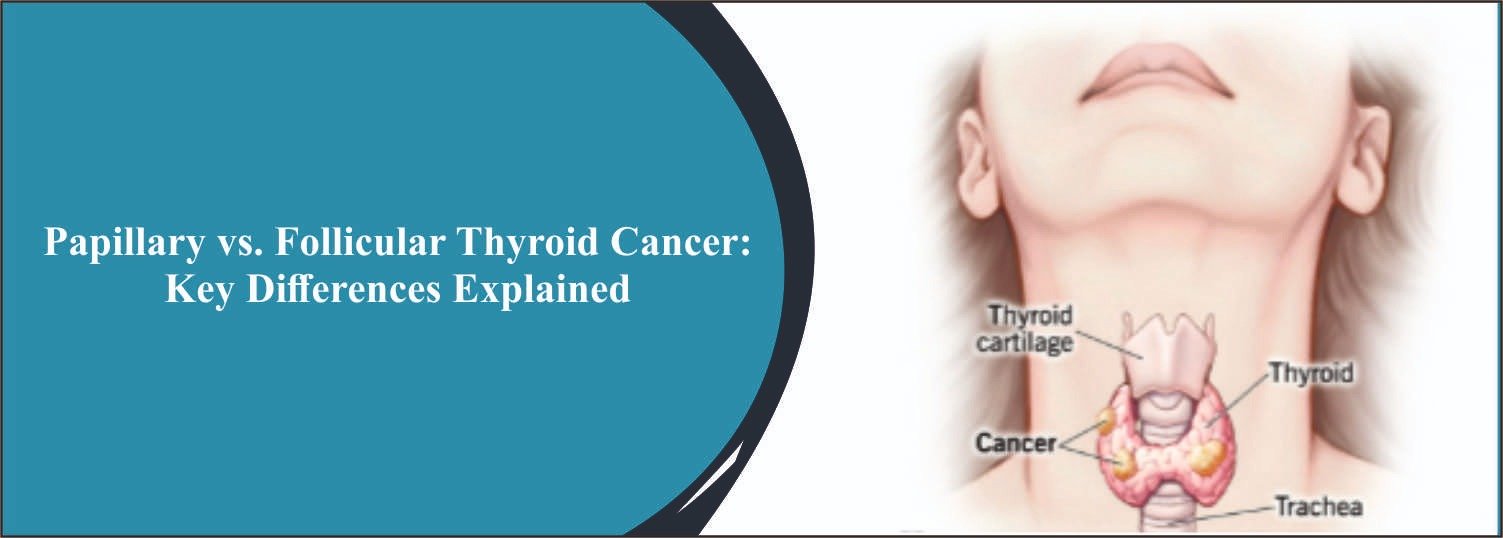
In thyroid cancer, an abnormal growth of cells becomes out of control, forming a tumor (mass of cells) in the thyroid gland, a small butterfly-shaped structure at the front of the neck. It has a significant role in metabolism regulation, heartbeat, body temperature, and other body functions. There are various types of thyroid cancer; they are all different in nature, spread to other parts of the body, and methods of treatment.
Papillary thyroid cancer and follicular thyroid cancer are the two most common types of differentiated thyroid cancer. Both arise from cells of a component of the thyroid gland - the follicular cells - but they differ in size, pattern of spread and some diagnostic characteristics. Being aware of the differences can also help patients to appreciate the nature of their diagnosis, and what investigations may be advised by doctors.
Dr. Nikunj Jain, a well-known Nuclear Medicine Specialist at Molecular Diagnostics and Therapy, explains the significance of Nuclear Medicine investigations in evaluation and follow-up of thyroid cancer patients. Depending on the stage and type of disease, radioactive iodine scans and selected PET-CT may be used for additional information.
What Is Papillary Thyroid Cancer?
The most common type of thyroid cancer is papillary thyroid cancer (PTC). It forms from the follicular cells, cells that typically make thyroid hormones. Growth is usually slow, and papillary thyroid cancer often spreads to nearby neck lymph nodes. Spread to distant organs is less common. It can also be a remote organ in certain cases, but this is not as frequent. Lots of patients have a good outcome, especially when the cancer is caught early.
The most common type of thyroid cancer is papillary thyroid cancer (PTC). It forms from the follicular cells, cells that typically make thyroid hormones. Growth is usually slow, and papillary thyroid cancer often spreads to nearby neck lymph nodes. Spread to distant organs is less common. It can also be a remote organ in certain cases, but this is not as frequent. Lots of patients have a good outcome, especially when the cancer is caught early.
What Is Follicular Thyroid Cancer?
Follicular thyroid cancer (FTC) is also a kind of differentiated thyroid cancer, which originates from the follicular cells of the thyroid. It is a less common form of thyroid cancer and more likely to happen at an older age. The spreading of follicular thyroid cancer into the blood is more common than that of papillary thyroid cancer. It may be systemic in distant organs, such as the lungs, bones, etc.
Follicular thyroid cancer (FTC) is also a kind of differentiated thyroid cancer, which originates from the follicular cells of the thyroid. It is a less common form of thyroid cancer and more likely to happen at an older age. The spreading of follicular thyroid cancer into the blood is more common than that of papillary thyroid cancer. It may be systemic in distant organs, such as the lungs, bones, etc.
Common Features of Follicular Thyroid Cancer
It is less common than papillary thyroid cancer.
It develops from thyroid follicular cells.
It can spread through blood vessels to distant organs.
The lungs and bones are among the common sites of distant spread.
Diagnosis requires evidence of capsular and/or vascular invasion in the tumour tissue.
It is less common than papillary thyroid cancer.
It develops from thyroid follicular cells.
It can spread through blood vessels to distant organs.
The lungs and bones are among the common sites of distant spread.
Diagnosis requires evidence of capsular and/or vascular invasion in the tumour tissue.
Papillary vs. Follicular Thyroid Cancer: Key Differences
Although both cancers develop from thyroid follicular cells, they have important differences.
Although both cancers develop from thyroid follicular cells, they have important differences.
What Causes Papillary and Follicular Thyroid Cancer?
Most cancers of the thyroid gland are thought to have an unknown cause. But there are some risk factors that can make the disease more likely to occur.
1. Radiation Exposure
Thyroid cancer has been linked with health hazards like exposure to ionising radiation, especially in childhood; for example, radiotherapy to the head or neck or from radioactive fallout increases the risk. Routine diagnostic X-rays do not significantly raise it. Health risks such as exposure to ionising radiation, especially during childhood, are known to cause thyroid cancer. History of head or neck radiation therapy may also be a risk factor.
2. Genetic Factors
Some genetic syndromes are genetically passed-on predispositions to an increased risk of certain types of thyroid cancer. This is also important to bear in mind if the family history is relevant, but most papillary and follicular thyroid cancers do not have a known inherited cause.
3. Age and Gender
Thyroid cancer can happen at any age, but for certain types of cancer, there can be differences concerning age. Also, far more women than men end up with a diagnosis of thyroid cancer.
How Are Papillary and Follicular Thyroid Cancers Diagnosed?
Diagnosis involves a combination of clinical examination, ultrasound, biopsy, and, when required, additional imaging investigations.
Diagnosis involves a combination of clinical examination, ultrasound, biopsy, and, when required, additional imaging investigations.
1. Physical Examination
Your doctor will check for lymph nodes or lumps in and around the thyroid gland, and for any abnormalities. The symptoms that the patient has and his/her medical history are also taken into account.
Your doctor will check for lymph nodes or lumps in and around the thyroid gland, and for any abnormalities. The symptoms that the patient has and his/her medical history are also taken into account.
2. Thyroid Ultrasound
Thyroid ultrasound is an imaging technique that uses sound waves (ultrasound) to produce pictures of the thyroid gland. It can assist doctors in determining the size, shape, and features of thyroid nodules, and in checking around the thyroid gland. A small sample of tissue may be taken by a thin needle (fine needle aspiration) to examine in the laboratory if suspicious nodules are present.
Thyroid ultrasound is an imaging technique that uses sound waves (ultrasound) to produce pictures of the thyroid gland. It can assist doctors in determining the size, shape, and features of thyroid nodules, and in checking around the thyroid gland. A small sample of tissue may be taken by a thin needle (fine needle aspiration) to examine in the laboratory if suspicious nodules are present.
3. Biopsy and Histopathology
Fine needle aspiration in most cases will be a very useful diagnostic biopsy to confirm the diagnosis of papillary thyroid cancer. It is, however, primarily important to look at the excised tissue to confirm that the diagnosis is correct: follicular thyroid cancer – capsular/vascular invasion versus follicular adenoma. A diagnosis of thyroid cancer, along with identification of the type of thyroid cancer, can be reached by histopathology, therefore.
Fine needle aspiration in most cases will be a very useful diagnostic biopsy to confirm the diagnosis of papillary thyroid cancer. It is, however, primarily important to look at the excised tissue to confirm that the diagnosis is correct: follicular thyroid cancer – capsular/vascular invasion versus follicular adenoma. A diagnosis of thyroid cancer, along with identification of the type of thyroid cancer, can be reached by histopathology, therefore.
4. Blood Tests
Blood tests might be used to measure the amount of thyroid function including the amount of TSH and thyroid hormone. In some patients, after treatment, thyroglobulin may be used as a tumour marker. Blood tests, however, cannot show if thyroid cancer is of the papillary or follicular type.
Blood tests might be used to measure the amount of thyroid function including the amount of TSH and thyroid hormone. In some patients, after treatment, thyroglobulin may be used as a tumour marker. Blood tests, however, cannot show if thyroid cancer is of the papillary or follicular type.
Role of Nuclear Medicine in Thyroid Cancer Evaluation
Nuclear medicine investigations can provide information about thyroid tissue function and the presence of thyroid cancer cells that take up specific radioactive tracers.
Nuclear medicine investigations can provide information about thyroid tissue function and the presence of thyroid cancer cells that take up specific radioactive tracers.
Radioactive Iodine Scan
Radioiodine imaging is a useful investigation in some cases of differentiated thyroid cancer. If papillary and follicular thyroid cancer cells retain their ability to absorb iodine, then it might still work. A patient may receive radioactive iodine treatment after thyroid surgery if the cancer is iodine-avid, and radioiodine imaging may be used for follow-up for other thyroid conditions in certain cases. Iodine imaging can be used. The final decision will be made on the patient's risk group, pathological diagnosis, and treatment implementation.
Radioiodine imaging is a useful investigation in some cases of differentiated thyroid cancer. If papillary and follicular thyroid cancer cells retain their ability to absorb iodine, then it might still work. A patient may receive radioactive iodine treatment after thyroid surgery if the cancer is iodine-avid, and radioiodine imaging may be used for follow-up for other thyroid conditions in certain cases. Iodine imaging can be used. The final decision will be made on the patient's risk group, pathological diagnosis, and treatment implementation.
PET-CT Scan
PET-CT is a combination of Positron Emission Tomography (PET) and Computed Tomography (CT) to give information on both metabolic activity and the location of abnormal tissue within the body. In thyroid cancer situations, in some cases it may be helpful to perform an 18F-FDG PET-CT scan when:
Thyroglobulin levels remain elevated or rise after treatment.
Radioactive iodine imaging does not identify the suspected disease.
Doctors need to investigate possible recurrent or metastatic disease.
Additional information is required for treatment planning.
Conclusion
They have different patterns of dissemination, differ in microscopic appearance, and differ in the manner and level of diagnostic requirements. Papillary thyroid cancer typically spreads to nearby lymph nodes, and follicular thyroid cancer is more apt to spread via the bloodstream to organs such as the lungs or bones.
Appropriate diagnosis requires the use of imaging and tissue study. Radioactive iodine imaging, PET-CT, and other nuclear medicine tests can be useful for further evaluation and often help in treatment planning and during follow-up in some patients. These tests are helpful for patients' treatment of thyroid cancer and can be explained with the help of an experienced expert like Dr Nikunj Jain.